


From Oyster Leases to Weekend Anglers: Beachmere’s Fishing Heritage
On most mornings in Beachmere, the foreshore is quiet. A few locals cast fishing lines into the bay, crab pots sit along nearby creeks, and the water moves slowly across the tidal flats of northern Moreton Bay.
It feels like a relaxed coastal suburb.
But long before Beachmere became a residential community, the shoreline was known as Toorbul Point and formed part of a working bay economy built on oyster leases, fishing boats and tidal harvests.
In the late 19th century, the waters between the mainland and Bribie Island supported oyster cultivation and fisheries that linked small settlements such as Donnybrook and Deception Bay to Brisbane’s seafood markets.
That history explains something important about Beachmere today. The bay was never just scenery. It was the reason the settlement existed in the first place
The Fishing Corridor of the Northern Bay
Beachmere’s fishing heritage cannot be understood in isolation. The suburb sits within a broader coastal system that includes the Pumicestone Passage, the sheltered channel separating Bribie Island from the mainland.
For generations, fishermen worked these calm estuarine waters where mangroves, tidal flats and sandbanks created ideal habitat for species such as bream, whiting and flathead.
Small settlements grew along this corridor, including Donnybrook and Toorbul further north. Beachmere formed the southern edge of this maritime landscape, giving local fishermen access to the same productive fishing grounds.
Because the Passage is protected from ocean swell, it historically provided safe operating conditions for small working boats. This made it a natural base for early fisheries across the northern part of Moreton Bay.
Beachmere’s long connection to the bay continues to shape the kind of homes buyers seek in the suburb today.
Recent Property Activity in Beachmere
While Beachmere remains a relatively quiet market compared with some neighbouring coastal suburbs, recent transactions show steady demand for larger homes and lifestyle properties close to the bay.
The strongest price in this group was achieved at 752 Beachmere Road, which sold for $1,650,000 in January. The property includes six bedrooms and three bathrooms on approximately 20,000 square metres, highlighting the appeal of acreage-style living close to the coast. The sale was handled by Kath Machen-Baxter.
Another notable sale occurred at 47 Bishop Road, which achieved $1,127,000 in December. The home offers four bedrooms and two bathrooms on a 1,154 square metre block, illustrating continued demand for larger residential lots in the suburb. The property was sold by Lisa Olver.
A nearby lifestyle property at 18 Murray Court changed hands for $1,100,000 in December. Set on approximately 26,300 square metres, the property includes three bedrooms and one bathroom, reflecting the strong interest in acreage-style homes that provide space and privacy within the Beachmere area. The sale was negotiated by Angela Le Fevre.
Together these transactions highlight the diversity of Beachmere’s housing stock, ranging from traditional residential blocks to larger lifestyle holdings that remain attractive to buyers seeking space near the ba
Recent Sales
• 752 Beachmere Road — $1,650,000 — Sold 09 Jan 2026
• 47 Bishop Road — $1,127,000 — Sold 23 Dec 2025
• 18 Murray Court — $1,100,000 — Sold 05 Dec 2025
• 20 Karora Road — $1,000,000 — Sold 06 Mar 2026
• 12 Riversleigh Road — $920,000 — Sold 17 Feb 2026
• 127 Rogers Street — $920,000 — Sold 15 Jan 2026
• 9 Prince Street — $883,000 — Sold 12 Feb 2026
• 28 Kunde Street — $865,000 — Sold 01 Dec 2025
• 27 Adam Street — $850,000 — Sold 10 Dec 2025
• 2/38 First Avenue — $845,000 — Sold 26 Feb 2026
Oyster Leases and the Bay Economy
Long before recreational fishing came to define Beachmere’s lifestyle appeal, Moreton Bay supported a substantial oyster industry, and the northern bay formed part of that working landscape. Oysters were cultivated, bagged, leased and shipped as a commercial product. Donnybrook was recognised as an oyster centre, with established banks, cultivation bags and company activity recorded in nearby waters. This was a regulated bay industry, not casual harvesting.
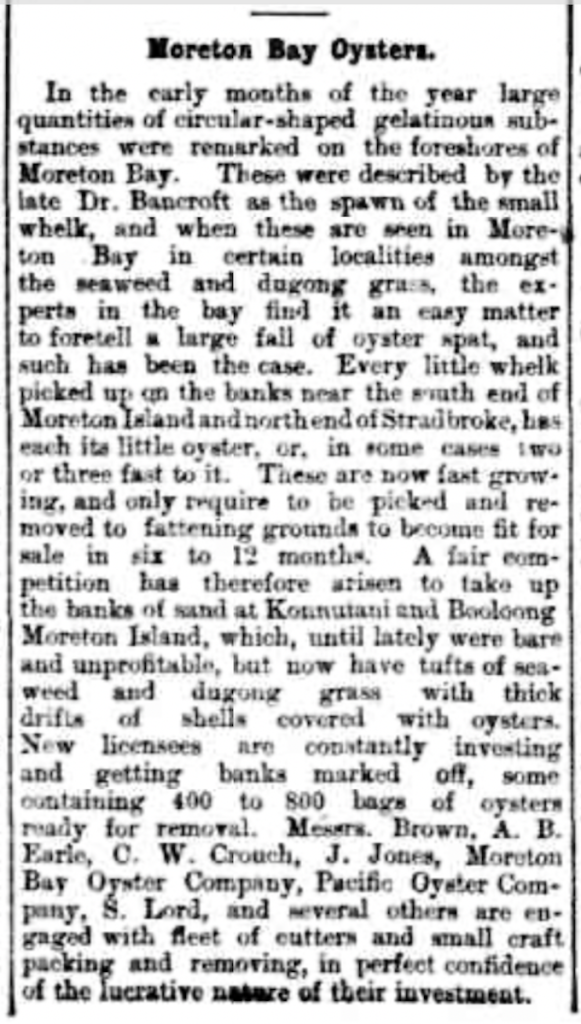
The industry depended on the sheltered character of the bay. Mudflats, tidal shallows, mangrove-fringed inlets and protected western waters created conditions suited to oyster growth and harvesting. For settlements along the mainland shore, including the district that became Beachmere, access to those shallow-water grounds gave the coastline real economic value. Fishing and oystering were part of the same maritime economy, built on tides, local knowledge and the ability to move produce from the bay to market.
By the early twentieth century, however, the industry was under visible pressure. Disease in the beds and official restrictions had become serious enough for oyster gathering to be prohibited for a year in parts of Moreton Bay in 1902 after earlier concerns about mud disease.
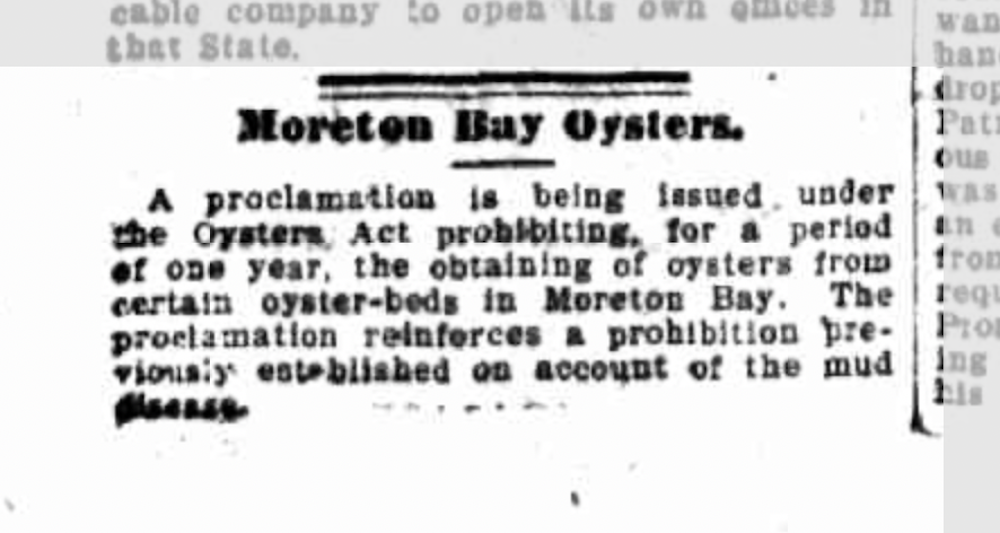
The decline was gradual rather than sudden, but the direction was clear: what had been a heavily worked oyster district in the late nineteenth century became less dominant as a commercial system over time.
From Working Bay to Recreational Bay
The weakening of the oyster industry did not end the bay’s economic importance; it changed its form.
Moreton Bay continued to support fishing, crabbing and, later, prawning, while Beachmere’s sheltered shoreline increasingly attracted local and visiting anglers.
Unlike the surf beaches on the eastern side of Bribie Island, Beachmere offered calm water, easy access to tidal flats and channels, and practical fishing grounds for people using the shore or small boats.

Over time, the bay shifted from a place defined by oyster leases and small-scale commercial extraction to one shaped by mixed uses: recreation, environmental management and ongoing local fishing culture. Modern research on Moreton Bay shows how valuable that recreational use became.
After the Marine Park rezoning in 2009 expanded protected areas from 0.5 per cent to 16 per cent of the bay, fishers strongly opposed the changes for fear of losing access and economic value.
Yet, the same study found that recreational fishing benefits may have increased, with the annual value of recreational fishing in Moreton Bay estimated at about AUD$20 million.
That longer history matters for Beachmere. The foreshore belongs to a bay that has been worked, managed and contested for generations.
First, it was oyster leases and extraction; later it became a marine landscape shaped by conservation, recreation and competing claims on the water.
A Fishing Identity That Endures
Beachmere’s fishing heritage sits inside that broader story of a bay whose value has never been purely scenic.
Locals still fish from the foreshore, set crab pots in nearby creeks and plan around tides, wind and season in ways that reflect the bay’s continuing influence on daily life.
The waterfront is no longer defined by oyster leases and commercial activity, yet it remains a place where people gather, launch small boats, watch the water and use the bay as part of their everyday routine.
In that sense, fishing in Beachmere is less an industry than a form of continuity.
That continuity helps explain the suburb’s character. Even as Beachmere has become more residential within a fast-growing region, its connection to the bay still gives it a slower, tide-shaped identity grounded in fishing, crabbing and quiet use of the foreshore.
Published 16-Mar-2026
Featured Image Credit: OzFish Unlimited/YouTube screengrab
