
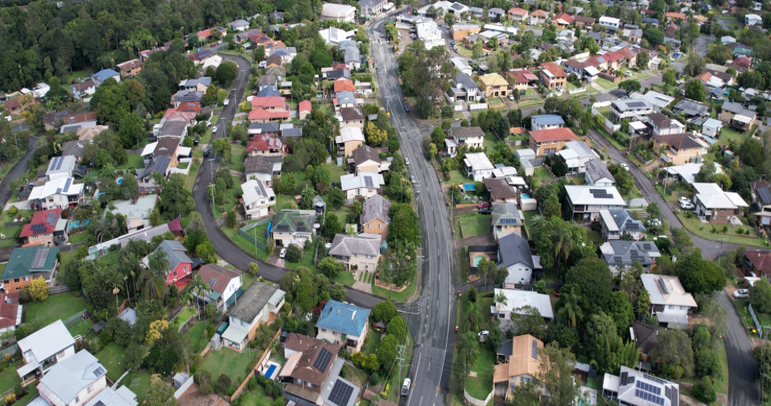

Ferny Hills at a Crossroads: Precinct Planning, Samford Road and Property Pressure
Ferny Hills is no longer just watching change happen next door.
While construction continues around Ferny Grove railway station, the City of Moreton Bay is advancing its own Ferny Hills Precinct Planning project — a process that will shape how the suburb grows, what gets built and how its character is preserved.
Taken together, the Samford Road upgrades, adjacent Transit Oriented Development (TOD) activity and the precinct planning process mark a structural moment for Ferny Hills.
The question is not whether change is coming.
It is how it will translate into property values.
PROPERTY MARKET SNAPSHOT — Ferny Hills
Before new planning settings are drafted and before roadworks conclude, 2025 sales data provides a clear baseline.
The highest recorded sale was 6 Carrama Crescent, which achieved $2,200,000. The seven-bedroom, four-bathroom home on 921m² was sold by Simon Brigdale of LJ Hooker Stafford. That figure places Ferny Hills firmly in executive-family territory.
Two further premium results followed. 26 Larwood Place sold for $1,550,000 — a five-bedroom, three-bathroom residence on 1,282m² handled by Peter Robertson and Melea Black-Sinclair of Position Property Services — while 23 Calca Crescent secured $1,540,000 for a four-bedroom, three-bathroom home on 655m².
The pattern is consistent: premium detached homes on substantial land parcels are driving the top of the market. Density-driven product is not setting price benchmarks in Ferny Hills — land and scale are.
Below that top tier, depth remains steady between $935,000 and $1.6 million, indicating broad buyer demand across the detached housing segment. If infrastructure upgrades improve commute reliability, this mid-band is where upward pressure would likely appear first.
2025 Ferny Hills Sales Snapshot
- 55 Teenan Street — $935,000 — 3 bed, 2 bath — 655 m²
- 25 Anora Crescent — $935,000 — 3 bed, 2 bath — 610 m²
- 67 Hutton Road — $1,225,520 — 3 bed, 2 bath — 660 m²
- 91 Kylie Avenue — $970,000 — 3 bed, 1 bath — 620 m²
- 85 Hutton Road — $1,095,999 — 3 bed, 1 bath — 615 m²
- 21 Bel Air Court — $1,500,100 — 4 bed, 3 bath — 802 m²
- 26 Larwood Place — $1,550,000 — 5 bed, 3 bath — 1,282 m²
- 23 Conlo Crescent — $1,075,000 — 4 bed, 1 bath — 607 m²
- 23 Calca Crescent — $1,540,000 — 4 bed, 3 bath — 655 m²
- 14 Wingara Grove — $1,200,000 — 3 bed, 2 bath — 607 m²
- 6 Carrama Crescent — $2,200,000 — 7 bed, 4 bath — 921 m²
- 9 Larwood Place — $1,615,000 — 4 bed, 2 bath — 825 m²
- 17 Cranwood Court — $1,575,000 — 4 bed, 2 bath — 700 m²
What’s Happening Next Door — And Why It Matters
The Ferny Grove Transit Oriented Development is being delivered in two stages.
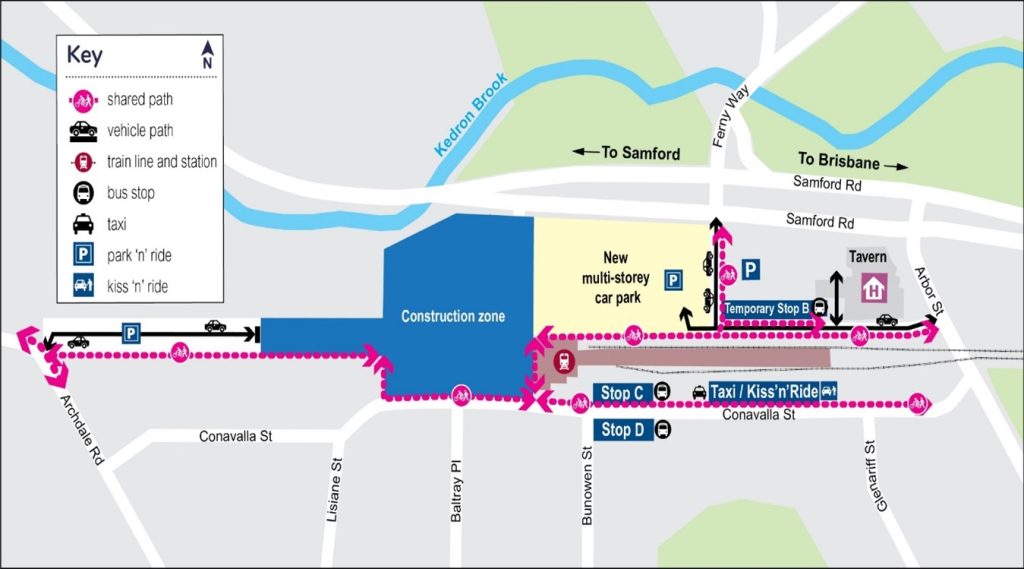
Stage 1 has already reached practical completion, delivering a 905-space multi-storey park ‘n’ ride facility, including 25 disability-accessible spaces across five levels. Importantly, it maintained overall commuter capacity during redevelopment, reducing the risk of parking shortages at the terminus.
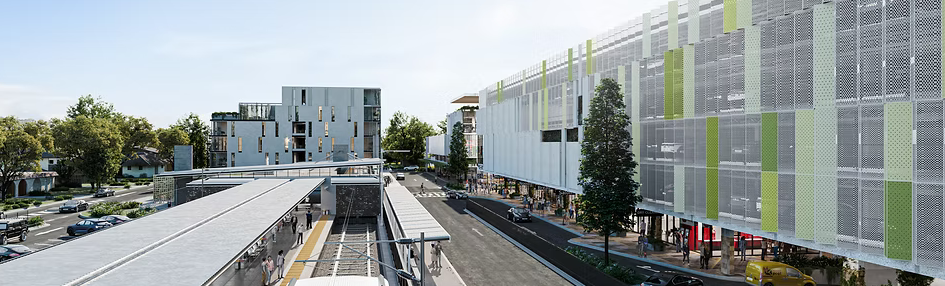
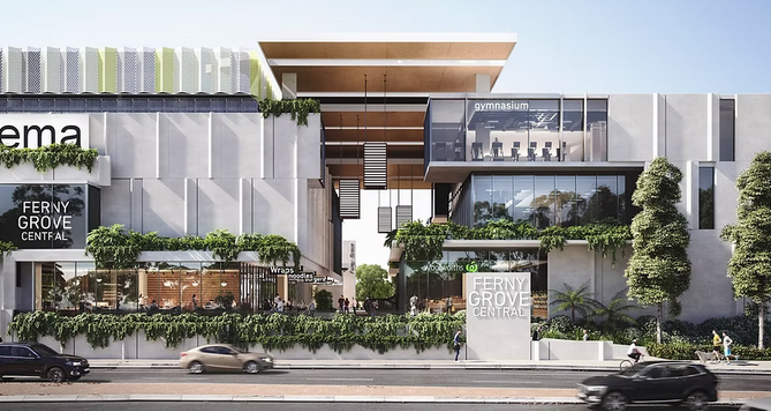
Stage 2, now under construction and tracking toward Q3–Q4 2026 completion, includes the Ferny Grove Central retail precinct, The Fernery Apartments residential development, new internal access roads, a new bus stop, upgraded kiss ‘n’ ride and new taxi ranks. Samford Road widening and culvert upgrades form part of the broader integration works.

For Ferny Hills, this matters in three ways.
First, commuter confidence. Parking certainty and improved interchange infrastructure strengthen the appeal of rail-based commuting for nearby suburbs.
Second, retail activation. Concentrated retail and entertainment uses adjacent to the station may shift local shopping and traffic patterns, particularly along the Samford Road corridor.
Third, density concentration. Apartments are being introduced at the station node rather than within Ferny Hills itself. Historically, this can sharpen the value proposition of neighbouring low-density suburbs offering larger blocks within comparable commute distance.
A Vision for Ferny Hills
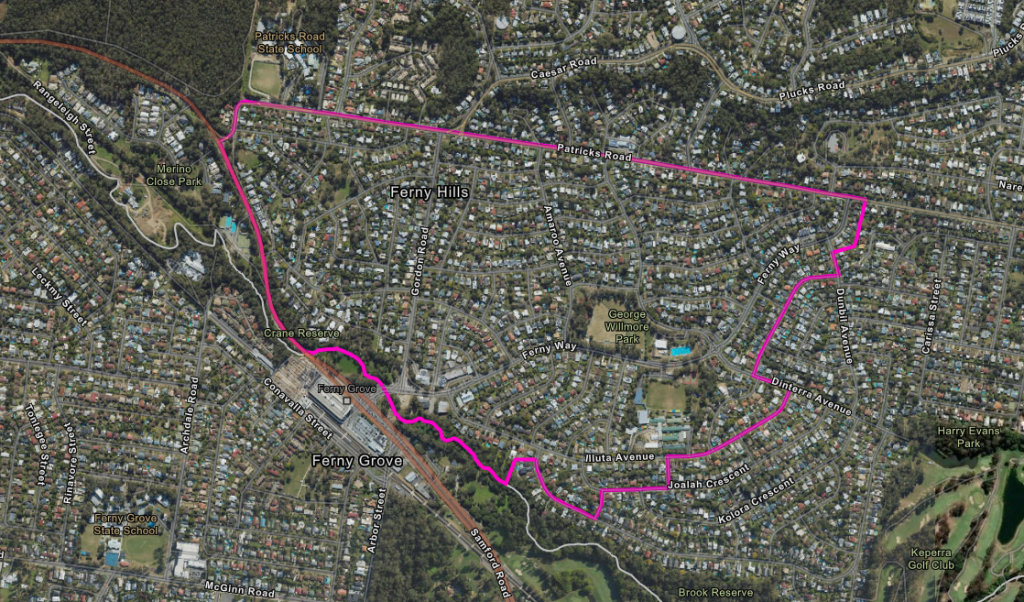
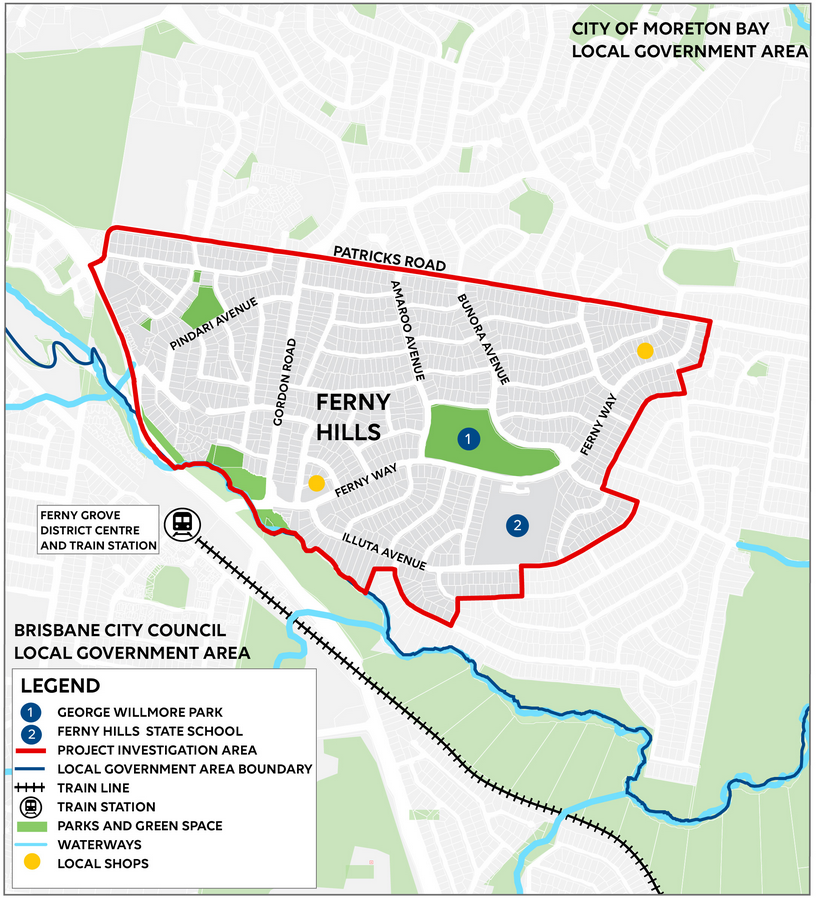
Separately, City of Moreton Bay is preparing a Future Directions Report to guide growth within parts of Ferny Hills. The investigation area sits close to the Ferny Grove train station and existing local shops, recreation parks and Kedron Brook.
Council has stated the goal is to guide future growth while recognising and enhancing local identity. The broader strategy aligns with Queensland Government housing objectives by increasing housing supply and diversity in built-up areas, while preserving 75% of the city as rural and natural space.
Between 19 May and 16 June 2025, the community was invited to contribute via an online pin map, vision wall and a pop-up consultation at the Hills Carnival. Council received 84 pins and 83 written comments.
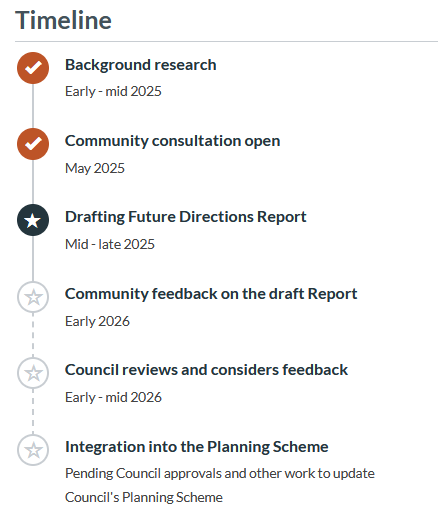
After the Future Directions Report in mid–late 2025, community feedback in early 2026, Council will take time for consideration before any integration into the Planning Scheme.
The stated focus areas include encouraging greater housing choice, improving connectivity, creating safe public spaces and strengthening local identity through design.
This is not a rezoning announcement.
But it is the stage where future density settings are shaped.
Planning Settings and Density Reality
Ferny Hills remains predominantly low-density under existing planning controls, with detached housing the dominant form. Most blocks fall within the 600m² to 800m² range, and 2025 sales confirm that premium pricing is being achieved by scale and land value rather than medium-density stock.
There is no current public proposal to rezone Ferny Hills for high-rise development. However, improved transport access and TOD activation can indirectly intensify surrounding markets through renovation activity, knockdown-rebuild projects and incremental infill applications.
Planning controls may remain unchanged.
Market demand may not.
Who Benefits — And Who Feels Pressure?
The 2025 data sets a clear benchmark: top-tier homes are already achieving between $1.5 million and $2.2 million.
If Samford Road upgrades deliver measurable congestion relief and improved connectivity, established homeowners stand to benefit first. Transport reliability typically strengthens buyer confidence, particularly for CBD commuters.
Renovators may also see expanded demand for upgraded homes within short reach of the station.
Entry-level buyers, however, are most exposed if the mid-band tightens. In a suburb dominated by detached housing, even modest upward movement can quickly reset affordability thresholds. Rental markets may respond if improved access supports lower vacancy rates.
Samford Road works are expected to run for approximately 12 months from July 2025, with Stage 2 of the TOD tracking toward late 2026 completion.
Ferny Hills does not host the TOD site. But its property trajectory will reveal whether infrastructure upgrades translate into lasting value — or simply short-term disruption.
Published 24-February-2026
Featured Image Credit: Ferny Hills Precinct Planning Project
