
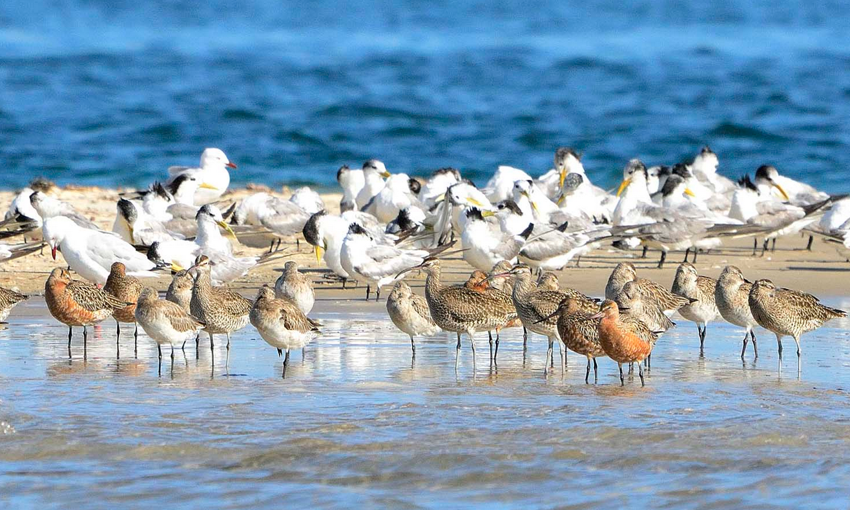

Banksia Beach and the 11,000km Commute That Depends on It
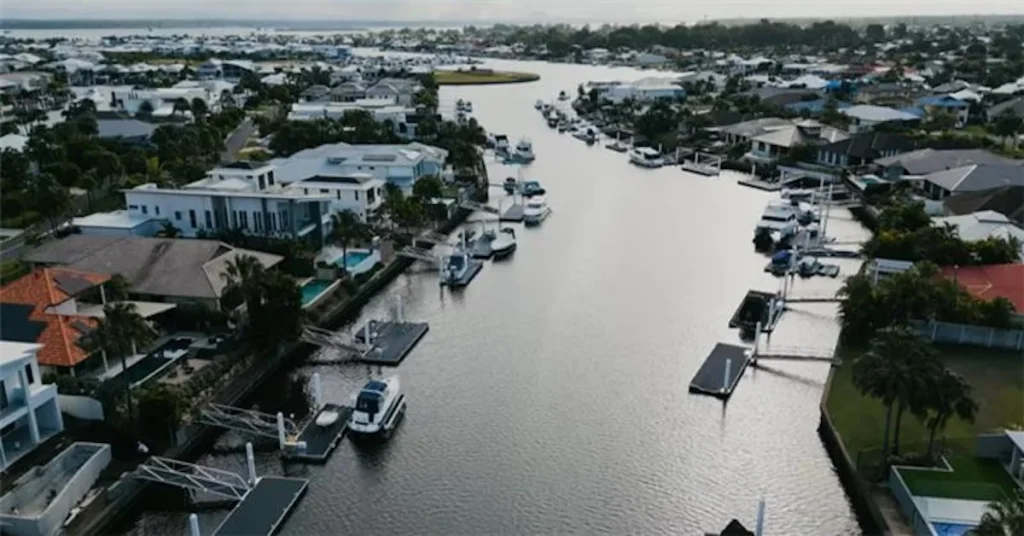
From the air, Banksia Beach looks like a quiet coastal suburb on Bribie Island. From a migratory bird’s perspective, it is part of one of the most important pit-stops on the planet.
Each year, shorebirds arrive in Moreton Bay after flying more than 11,000 kilometres non-stop from the Arctic. Many reach Queensland’s shores exhausted and dangerously low on energy. The mudflats around Moreton Bay are where they land to survive.
QUICK LINKS TO SECTIONS BELOW
- The Extreme Athletes of the Avian World
- Part of a Global Wetland Network
- A Hidden Freshwater World
- The Economic Engine Beneath the Mud
- Where Local Stewardship Meets Global Migration
Recent High-Value Sales in Banksia Beach
As the winter property market naturally slows down, interest rates and a drop in consumer confidence are causing days on market to billow. Despite that, the Banksia Beach property market has found a new level of appeal since COVID. Elena Stevens has seen a huge increase in listings and Leon Rosenow says that in the 16 years he has been on Bribie, the recent demand has been significantly above the previous 15 years.
Banksia Beach’s premium housing market has remained active through the first half of 2026, with a series of high-value transactions highlighting continued demand for waterfront, golf-course and lifestyle-oriented homes. Several properties sold above $1.7 million during the past three months, reinforcing the suburb’s position as one of Bribie Island’s most sought-after residential locations.
The highest recorded sale during this period was 27 The Promontory, which achieved $2,250,000. The four-bedroom residence on a substantial 970-square-metre site was sold by Elena Stevens of Elena Stevens Real Estate. Properties in this tightly held enclave rarely become available, and results at this level demonstrate the premium buyers continue to place on quality homes in established coastal settings.
Another standout transaction occurred at 20 Marlin Court, which sold for $1,875,000. The five-bedroom, three-bathroom home was marketed by Bryce Hawkins and attracted strong interest due to its generous landholding and family-focused design.
Rounding out the top tier was 10 Topsail Circuit, which changed hands for $1,800,000. The four-bedroom property sits within one of Banksia Beach’s most desirable residential precincts, reflecting the ongoing appeal of larger homes positioned close to the suburb’s waterways and recreational amenities.
Further evidence of the strength of the upper-end market can be seen across properties such as 39 Aquila Circuit and 4 Vanillalily Close, both exceeding $1.7 million. Across the board, buyers continue to show a preference for modern family homes offering larger floorplans, outdoor entertaining areas and proximity to the water.
Recent Sales (Last 90 Days)
- 27 The Promontory — $2,250,000 — sold 9 Apr 2026
- 20 Marlin Court — $1,875,000 — sold 26 Mar 2026
- 10 Topsail Circuit — $1,800,000 — sold 30 Mar 2026
- 39 Aquila Circuit — $1,720,000 — sold 9 Apr 2026
- 4 Vanillalily Close — $1,700,000 — sold 24 Mar 2026
- 223 Freshwater Drive — $1,602,000 — sold 27 Apr 2026
- 9 Eagle Court — $1,575,000 — sold 18 May 2026
- 1 Shearwater Crescent — $1,525,000 — sold 23 Apr 2026
- 10 Foxtail Crescent — $1,500,100 — sold 5 May 2026
- 23 Caleana Close — $1,465,000 — sold 8 Jun 2026
For residents and property owners in Banksia Beach and nearby Bongaree, this ecological system forms an unusual backdrop to everyday coastal living.
The same calm waterways that attract boating, fishing and waterfront homes also support one of the most important migratory bird habitats in the southern hemisphere.
The Extreme Athletes of the Avian World
Among the birds arriving in Moreton Bay each year are some of the most extraordinary endurance flyers on the planet.
Bar-tailed Godwit
- Widely regarded as the champion of long-distance bird migration.
- Unlike ducks or gulls, godwits cannot land on water to rest. Once airborne, they must continue flying until land appears.
- Satellite tracking has recorded flights of 11,690 kilometres non-stop, lasting roughly nine days.
- By the time they reach Queensland waters, many birds have burned through large portions of their body mass simply to stay aloft.
For these birds, the mudflats of Moreton Bay are not optional stopovers. They are the difference between survival and collapse.
Far Eastern Curlew
- The largest migratory shorebird in the world, recognised by its long down-curved bill.
- Now listed as critically endangered after major population declines across the flyway.
- Moreton Bay is one of its most important refuges, supporting a significant share of the global population.
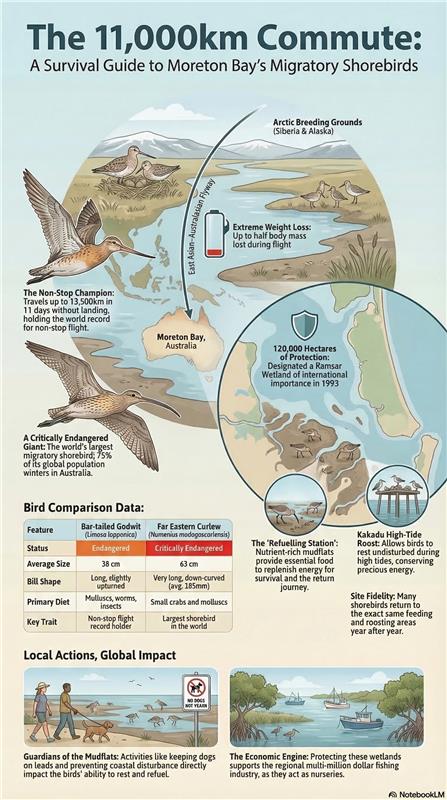
Research by the Queensland Wader Study Group has also revealed strong site fidelity. Many birds return to the exact same feeding areas year after year.
Some juveniles even remain in the bay for several years before attempting their first migration north, effectively using the region as a nursery.
That loyalty makes the protection of specific mudflats and roosting areas essential. When habitat disappears, these birds do not simply relocate elsewhere.
One of those critical locations sits quietly along the shoreline of Banksia Beach.
Kakadu High-Tide Roost at Banksia Beach
The Kakadu Artificial High-Tide Roost is a purpose-built site managed by the City of Moreton Bay to give migratory shorebirds a safe place to rest when tidal feeding flats are underwater. It is one of only two artificial roosts in the region, alongside the site at Ned Bishop Park.
During high tide, birds gather at Kakadu to rest, preen and conserve energy before returning to feed once the tide recedes. That rest is vital for species that may travel up to 25,000 kilometres annually along the East Asian–Australasian Flyway.
Because even minor disturbance can force birds into energy-draining flight, public access to the roost is strictly prohibited.
The site sits within the Moreton Bay Ramsar wetland, an internationally recognised ecosystem that supports around 40,000 migratory shorebirds each year in the Pumicestone Passage.
Unlike natural roosts, Kakadu requires active management. Environmental teams maintain open landscapes preferred by shorebirds through measures such as weed control and selective mangrove removal, ensuring birds retain clear sightlines to detect predators.
Together with other protected sites across the passage, Kakadu forms part of a network designed to safeguard migratory birds arriving in Moreton Bay after some of the longest journeys in the natural world.
The Kakadu Artificial High-Tide Roost in Banksia Beach, adjacent to the Pumicestone Passage, provides a protected resting site where birds can wait out the rising tide before returning to feed.
These engineered roosts have become increasingly important as natural coastal habitats face pressure from development and sea-level change.
By offering undisturbed resting areas close to feeding grounds, they allow birds to conserve the energy needed to complete journeys spanning entire hemispheres.
Part of a Global Wetland Network
The Kakadu roost forms part of a much larger ecological system.
Moreton Bay was designated a Wetland of International Importance under the Ramsar Convention in 1993. Covering more than 120,000 hectares, the site is globally significant for the number of waterbirds it supports and its role within the East Asian–Australasian Flyway.
The bay regularly supports tens of thousands of migratory shorebirds, along with many resident species that rely on the same habitats year-round.
The mudflats, mangroves, seagrass beds and tidal channels form a highly productive ecosystem that provides both food and shelter for wildlife across the region.
A Hidden Freshwater World
Beyond the tidal systems, the islands of Moreton Bay also contain unusual freshwater habitats.
“Wallum” ecosystems on nearby islands host perched lakes, rare wetlands formed when impermeable sand layers trap freshwater above the surrounding water table.
These acidic, nutrient-poor waters support specialised species sometimes called “acid frogs,” including the Wallum Sedgefrog and other organisms uniquely adapted to low-pH environments.
While less visible than the tidal mudflats, these habitats are another reminder of how biologically diverse the broader Moreton Bay region is.
The Economic Engine Beneath the Mud
From a purely economic perspective, the ecological health of Moreton Bay also underpins major regional industries.
Although the bay represents only a small proportion of Queensland’s coastline, it produces a significant share of the state’s seafood.
Commercial fisheries operating in the region generate tens of millions of dollars annually, while recreational fishing contributes hundreds of millions more to the local economy.
Mangroves, seagrass beds and tidal wetlands act as natural nurseries for prawns, crabs and fish species that sustain these industries.
Environmental resilience, in other words, is also a foundation of the region’s coastal economy.
Where Local Stewardship Meets Global Migration
The journey that begins in the Arctic tundra ultimately depends on decisions made much closer to home.
Soil erosion upstream, urban runoff and coastal disturbance can all affect the health of the mudflats where migratory birds refuel.
Small local actions, such as keeping dogs on leads near shorebird habitats or protecting sensitive coastal areas, ripple through an ecological chain that stretches across continents.
For residents of Banksia Beach and Bongaree, the quiet waters of the Pumicestone Passage are part of everyday life.
For migratory shorebirds arriving from the far north, they are the most important pit-stop on an 11,000-kilometre commute.
Published 16-June-2026
Featured Image Credit: Healthy Land & Water

