

Growth Without Losing Liveability: Warner’s Next Chapter
On a weekday morning in Warner, the suburb feels like it’s running two timelines at once. There’s the familiar rhythm — school drop-offs, short commutes, quick stops at the shops — and alongside it, the steady pulse of change: construction traffic, new estate signage, and land that seems to look different each time you pass it.
From survey lines to farm country
That sense of transition isn’t new here. Long before Warner became a recognisable suburb, the area west of Strathpine was defined by open farmland and rural routines. The suburb takes its name from James Warner, an early surveyor in the Moreton Bay district whose work in the mid-19th century helped map land parcels as Queensland shifted from penal settlement to free colony.
For decades after those early surveys, Warner remained agricultural. Well into the 20th century, it formed part of a broader farming district known for potato growing and small-scale rural production. Roads like Old North Road and Kremzow Road were practical rural links between properties, not the suburban connectors they would later become.
A small school and a long memory
Early community life reflected that scale. Warner State School opened in 1876, serving local families for more than sixty years before closing in the late 1930s. Today, the former school site survives as a residential address — a quiet reminder that Warner’s beginnings were once far removed from suburban life.

Photo Credit: Moreton Bay Region Libraries PRLPC-P1472 – John Armstrong, 1976
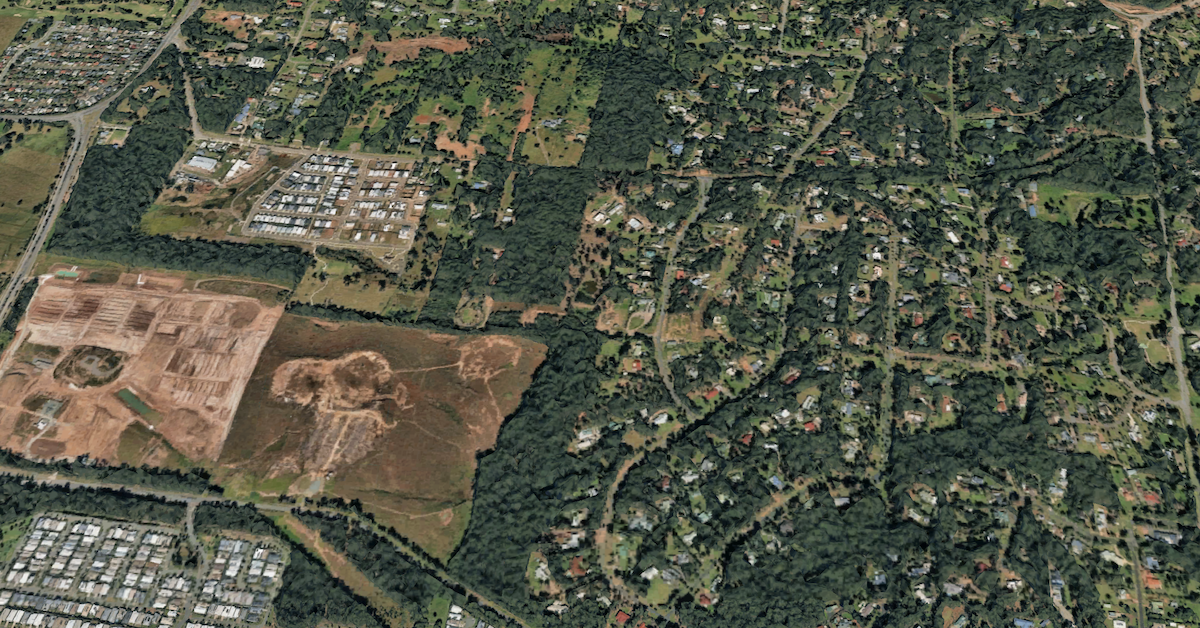
Even as Brisbane expanded north through the post-war decades, Warner held onto its rural character longer than many surrounding areas. Aerial photographs from the 1990s show paddocks, quarries and only the faint outlines of what would later become housing estates — a stark contrast to the suburb’s present form.
The pivot years: drive-in to housing, estates to neighbourhoods

Photo Credit: Moreton Bay Libraries PRLPC-P1264/2 – Cathy Roffey, ca. 1994
The shift toward suburbia gathered pace in the mid-1990s, when a former drive-in theatre near the intersection of Samsonvale Road and Old North Road was redeveloped into one of Warner’s first modern housing estates. Once a shared social space for surrounding rural communities, the site was progressively subdivided over the following decade — a visible turning point as open land gave way to suburban street grids.


A more structured wave of development followed in 2005 with the release of Warner Lakes, southwest of the Old North and Kremzow Roads intersection. Planned to deliver around 1,100 homes, the estate helped cement Warner’s transition from scattered rural parcels to a coherent residential neighbourhood. Population growth followed quickly, and Warner developed a noticeably youthful profile as families and younger households were drawn to its space, accessibility and lifestyle.
Growth layered, not sudden
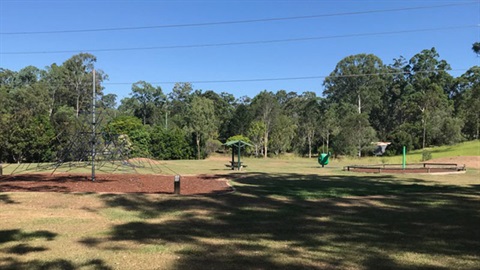
Today, that earlier expansion frames Warner’s current moment. The suburb is no longer emerging; it is maturing. New housing is arriving in a place that already has schools, shops and recreation embedded into daily life — from MarketPlace Warner and its supermarkets to open-space anchors like Frank Nichols Reserve and Warner Lake. Growth now layers onto an existing community rather than filling empty paddocks.

Photo Credit: moretonbayqld.gov.au
This layering is visible in newer developments such as Élan, now moving through staged delivery. Alongside housing, Élan has introduced a Community Stewardship Program, including a partnership with the Moreton Bay Wildlife Hospital Foundation, aimed at supporting wildlife care and environmental awareness. The developer points to the ecological sensitivity of the wider region — home to hundreds of recorded animal species — as context for that approach.

Whether such initiatives meaningfully offset the environmental footprint of development is a question that will only be answered over time. What they do reflect is a shift in expectations. Growth today is examined more closely than it was two decades ago, with residents paying attention not just to how much is built, but how new communities fit into the places they inherit.
Planning that shows up in daily life

It’s also clear that Warner’s current pressures aren’t driven by a single project. Earlier estates such as The Sanctuary, delivered in stages over many years and still completing later phases, combined with ongoing infill development across the suburb, have steadily increased population and density. New projects arrive on top of that foundation, not onto a blank slate.
Planning frameworks and zoning decisions may be debated on paper, but their impact is experienced in small, daily ways — a new estate entrance, altered traffic patterns, construction edging closer to established streets. When infrastructure delivery lags behind approvals, the gap is felt less as a policy issue and more as a daily negotiation.
Infrastructure lag and the Kremzow Road reality

Regional Development, Communications, Sport and the Arts
Nowhere is that more apparent than on the roads. Kremzow Road remains a key connector between Warner, Brendale and surrounding arterial routes. Safety upgrades delivered under a federally funded Black Spot program addressed specific risks through drainage works, realignment and roadside improvements. But those works were about safety, not capacity.
As residential density has increased, traffic volumes have risen with it. Congestion and queuing are now familiar, particularly during peak periods. For residents, the frustration isn’t just about slower travel, but about predictability — school runs that need padding, errands that take longer than expected, and daily routines that feel less flexible than they once did.
Warner properties pushing deeper into the $1m+ range
Between December 2025 and January 2026, a wave of Warner sales showed just how normal seven-figure prices have become for family homes in the suburb:
- a 4-bedroom house sold for $1.32m at 17 Solomon Parade
- a 4-bedroom house sold for $1.275m at 16 Corella Crescent
- a 4-bedroom house sold for $1.2m at 9 Belmore Court
- a 3-bedroom house sold for $1.08m at 52 Moor Circuit
- a 3-bedroom house sold for $1.035m at 24 Ballyalla Crescent
- a 4-bedroom house sold for $1.03m at 11 Boyne Place
- a 4-bedroom house sold for $1.01m at 69 Cootharaba Crescent
And at the top end, one standout sale reinforced the premium attached to rare land size in Warner:
- a 4-bedroom house sold for $1.575m at 5 Sally Court
Together, these results suggest Warner’s seven-figure sales are no longer exceptions, but increasingly part of the suburb’s new baseline for family homes. Even as more housing comes online, the pace of demand is keeping prices firm — and for many buyers, the competition is now built into the cost of entry.
Liveability beyond the numbers
Despite these pressures, much of what drew people to Warner remains. Green space still matters. Parks and reserves are more than landscaped buffers; they are part of everyday life. As the suburb fills in, residents are increasingly attuned to the difference between spaces that simply meet planning conditions and those that genuinely support how people live.
What comes next
In many ways, Warner has become a case study in outer-metro growth. Demand remains strong. Housing continues to be delivered. Yet affordability pressures persist, infrastructure strains are visible, and expectations are evolving.
From potato fields and a small rural school to a layered suburban community, Warner’s story has always been one of change. The question now is whether that change can continue without losing the balance that made the suburb attractive in the first place — not just space and proximity, but a sense that growth, when it comes, still leaves room to breathe.

Featured Image Credit: Google Maps screengrab
