


The Mill at Moreton Bay: From Paper Mill to University City — And What It Means for Petrie Property
When the former paper mill closed, Petrie lost the industrial employer that had defined it for generations.
For decades, the site operated as one of the region’s major manufacturing hubs, originally established in the 1950s and later run by Australian Paper and Amcor. At its peak, the mill employed hundreds of workers and anchored local economic activity along the North Pine River.
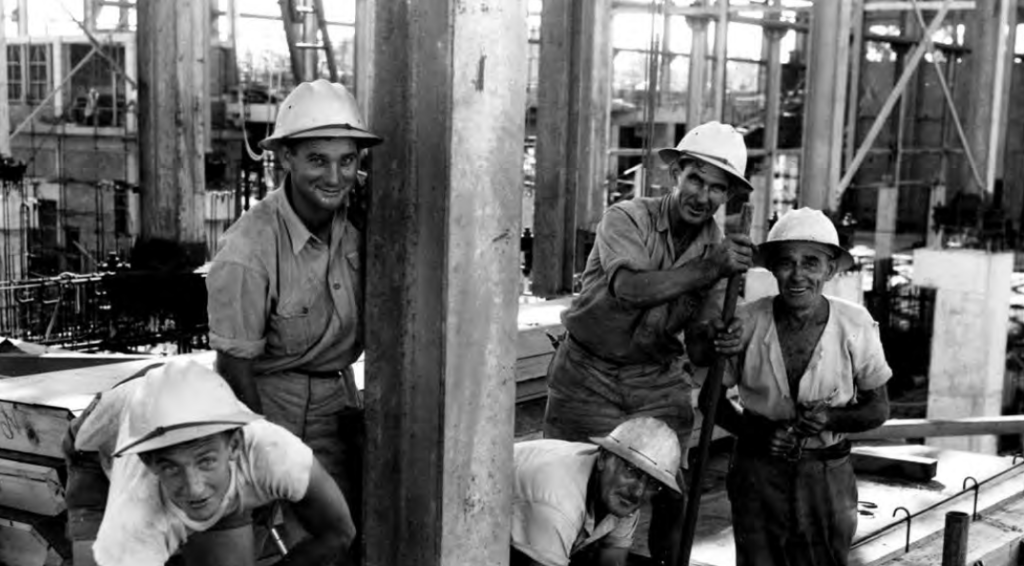
When production ceased in the 2010s, it marked the end of Petrie’s industrial chapter — and left behind one of South East Queensland’s largest brownfield redevelopment opportunities.
What replaced the old mill is not simply a redevelopment site. The Mill at Moreton Bay is a 460-hectare Priority Development Area anchored by the University of the Sunshine Coast’s Moreton Bay campus — and structured to reposition the region from manufacturing to knowledge economy.
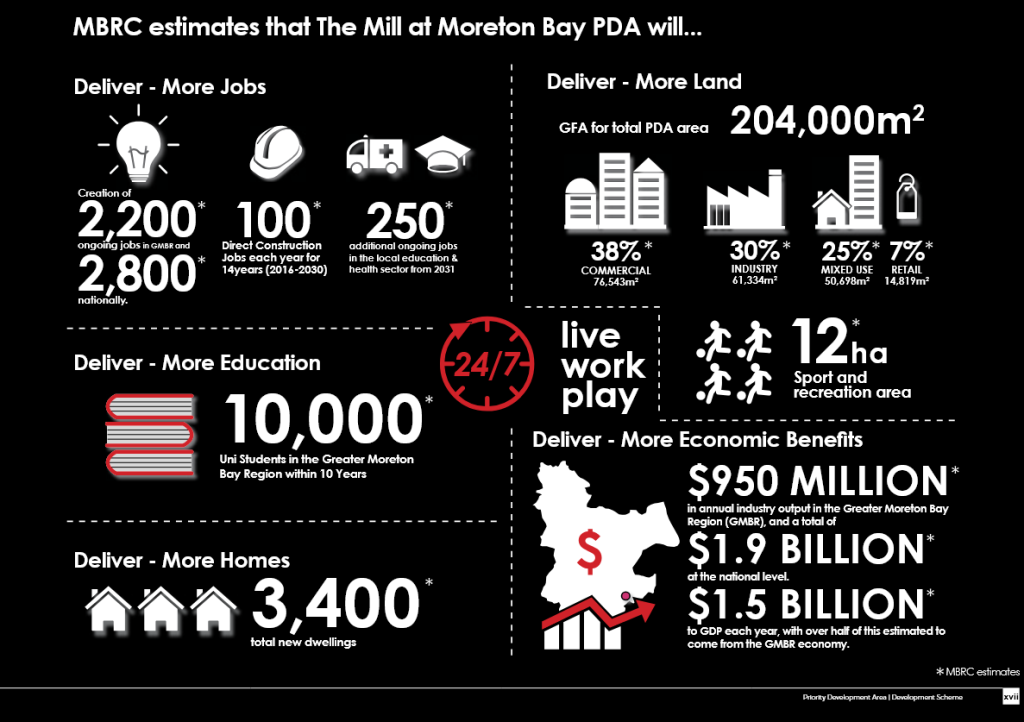
The development scheme is explicit about the scale. The Mill is intended to deliver 3,400 new dwellings and 204,000 square metres of gross floor area, broken into 76,543m² commercial, 61,334m² industry, 50,698m² mixed use and 14,819m² retail. Long-term modelling anticipates up to 6,000 ongoing jobs in the Greater Moreton Bay Region by 2036 and almost $950 million in annual local industry output.
At the centre of that shift is the university.
The planning vision describes a “full-service university campus” as the anchor around which health, commercial, residential and innovation uses are structured. This is not a satellite learning centre. It is designed to host thousands of students over time, expand course offerings beyond 100 programs, and embed STEM, business, engineering and health education within the region.
For Petrie property owners, that distinction matters. Universities change the economic gravity of suburbs.
Before unpacking how, it is worth looking at what the market is currently doing.
Recent Petrie Sales Snapshot
Just before Christmas, Patrick D’Arrigo sold 44 Affleck Avenue for $1.5 million, a 5 Bedroom, 2 Bathroom house on 1000 square metres of land.
Also just before Christmas, Mark Rumsey sold 7 Kroning Court for $1.3 million, a 4 bedroom, 2 Bathroom house on 901 square metres.
- 44 Affleck Avenue, Petrie — $1,500,000
- 7 Kroning Court, Petrie — $1,300,000
- 15 Hopkins Street, Petrie — $1,240,000
- 3 Cardinet Court, Petrie — $1,212,800
- 55 Hunter Circuit, Petrie — $1,180,000
- 91 Frenchs Road, Petrie — $1,140,000
- 42 Woodlands Avenue, Petrie — $1,130,000
- 5 Vaucluse Crescent, Petrie — $1,125,000
- 7 Ruby Crescent, Petrie — $1,090,000
- 62 Affleck Avenue, Petrie — $1,090,000
The clustering of multiple $1.1 million-plus results is notable.
Historically, Petrie was not consistently producing this volume of seven-figure sales. The suburb’s price ceiling was lower when it functioned primarily as a rail-linked commuter location. The emergence of repeated million-dollar transactions suggests the ceiling may already be lifting — particularly for larger homes and premium streets.
Is Petrie Still Undervalued?
Markets tend to price what exists today. This does not automatically mean Petrie is “undervalued”, but it does indicate a market recalibration may be underway.
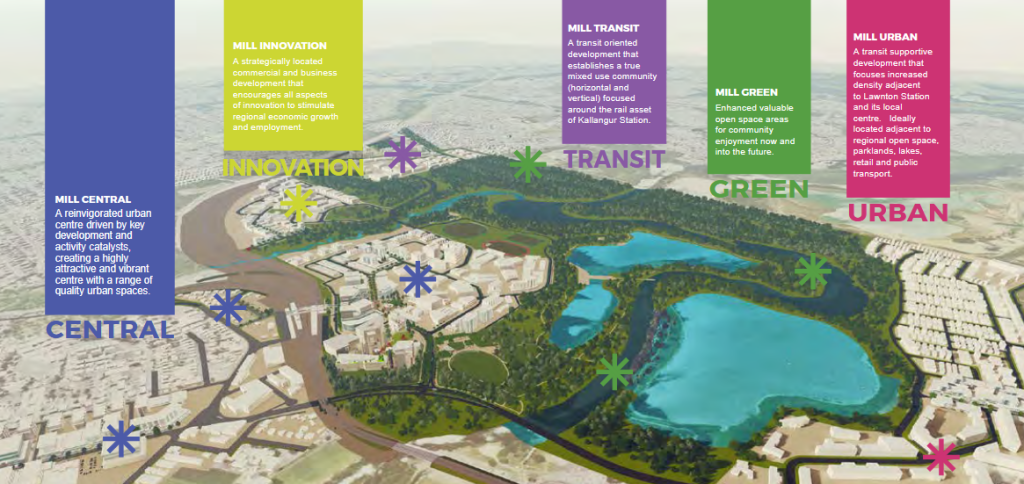
The planning framework anticipates thousands of students, significant commercial tenancy, expanded health and research activity, and multi-stage residential intensification adjacent to rail.
If the campus continues to scale — and associated commercial uptake follows — Petrie transitions from a commuter suburb into an employment and education node.
That shift typically widens the buyer pool. Students create rental demand. Academic and professional staff add stable owner-occupier demand. Businesses co-locating near the campus create white-collar employment within walking distance of housing.
The development scheme’s language is deliberate. It emphasises transit-oriented intensification, mixed-use activation and co-location of innovative businesses with the university.
That combination is rarely accidental in property markets.
The University as Economic Anchor
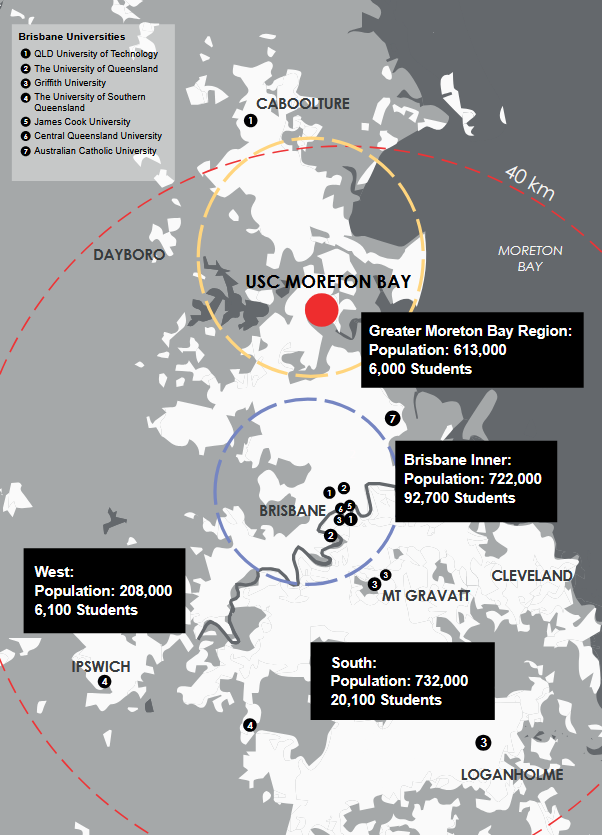
Universities do more than teach. They anchor research partnerships, professional services, allied health clinics, incubator spaces and start-ups. The Mill Innovation precinct is structured specifically to encourage that clustering.
The University of the Sunshine Coast Moreton Bay campus is positioned as the catalyst for the broader precinct. The planning document describes the PDA as becoming home to “innovative businesses or organisations that want to co-locate with a university”.
That co-location principle is central.
Without commercial absorption, graduates leave. With it, they stay.
Local principal John Schuh captured that sentiment early, saying the project would “unlock endless opportunities to transition from high quality secondary education to local STEM-focussed tertiary studies and highly-skilled employment closer to home.”
That “closer to home” factor is the retention lever. It reduces the outflow of young adults to Brisbane CBD or interstate.
Post-graduate student and local resident Tara Murphy noted that having a university nearby provides “easier access to advanced learning facilities.” That access matters not only for school leavers, but for mature students and career-changers within the region.
The development scheme explicitly references flexible education pathways for school leavers, workers, parents and mature students. That broadens participation and deepens local engagement with the campus.
Mill Central: Campus Meets Main Street
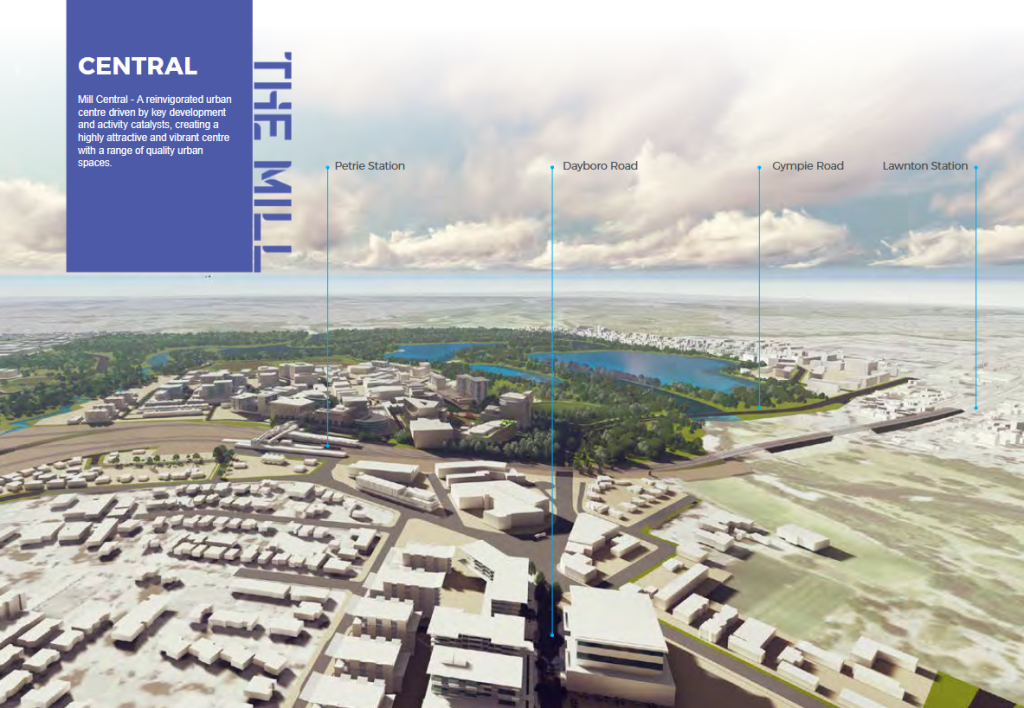
Mill Central is designed as the urban heart of the precinct, directly integrating with Petrie Station. It allows office, health care services, education, retail, food and drink outlets and community uses.
The scheme calls for high-visibility buildings addressing Gympie Road and landmark architectural responses at key sites, effectively creating a new main street environment linked to the campus.
In practical terms, that means students and workers activating cafés, retail tenancies and service providers. It also means greater pedestrian flow between rail and residential areas.
That shift in daily movement patterns changes how a suburb functions.
Mill Innovation: Where Graduates Work
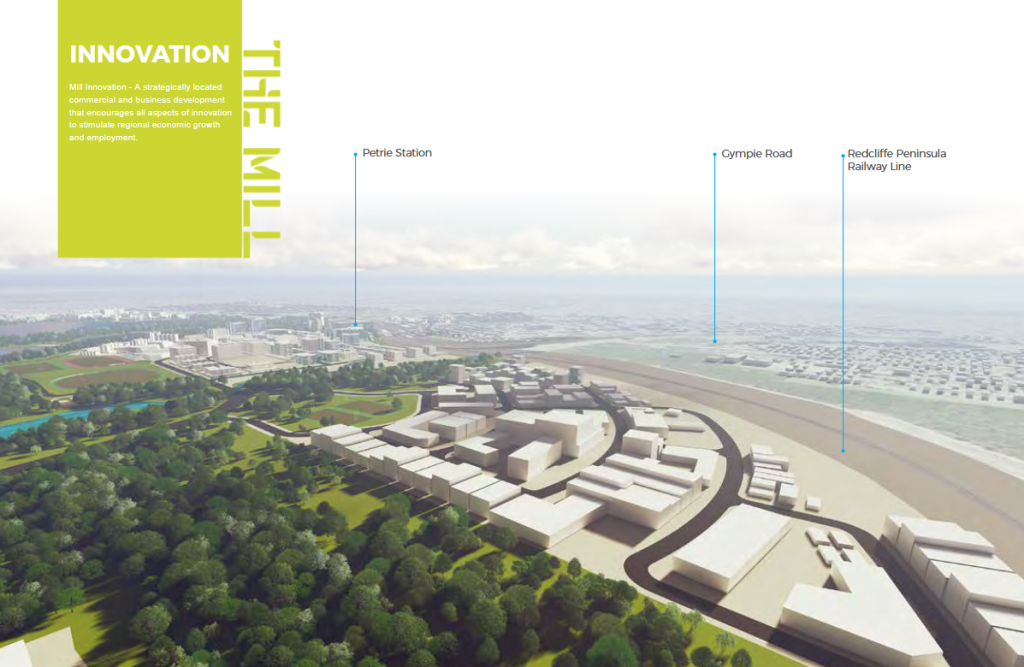
Mill Innovation is positioned as the employment layer, encouraging commercial and incubator uses alongside limited convenience retail.
The framework supports interim activation — markets, pop-ups, food vans — to generate early vibrancy before full commercial build-out.
As Sharon Armstrong from the North Lakes Chamber of Commerce observed, universities bring “new knowledge, new experiences and more people into the local area.” That influx drives demand not just for education, but for legal, accounting, health, tech and consulting services.
If those firms establish within the precinct, graduate retention increases — and so does household income diversity within Petrie.
Mill Urban and Mill Transit: Residential Intensification Around Rail
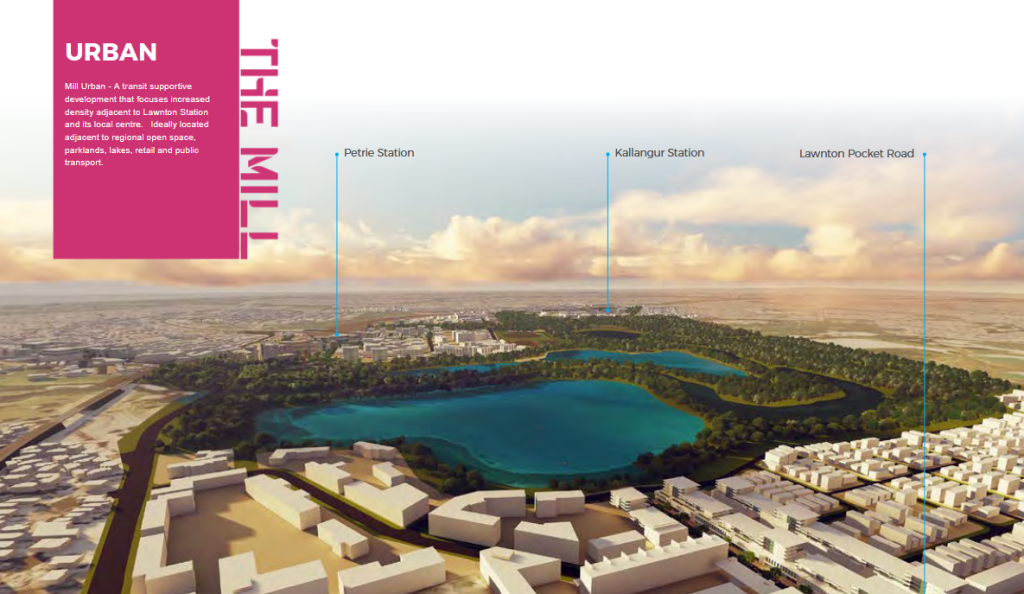
Mill Urban introduces medium and higher-density residential product near Lawnton Station, requiring a mix of detached homes, terraces, apartments and retirement living. In designated areas, a minimum density of 75 dwellings per hectare applies, with building heights up to 27 metres.
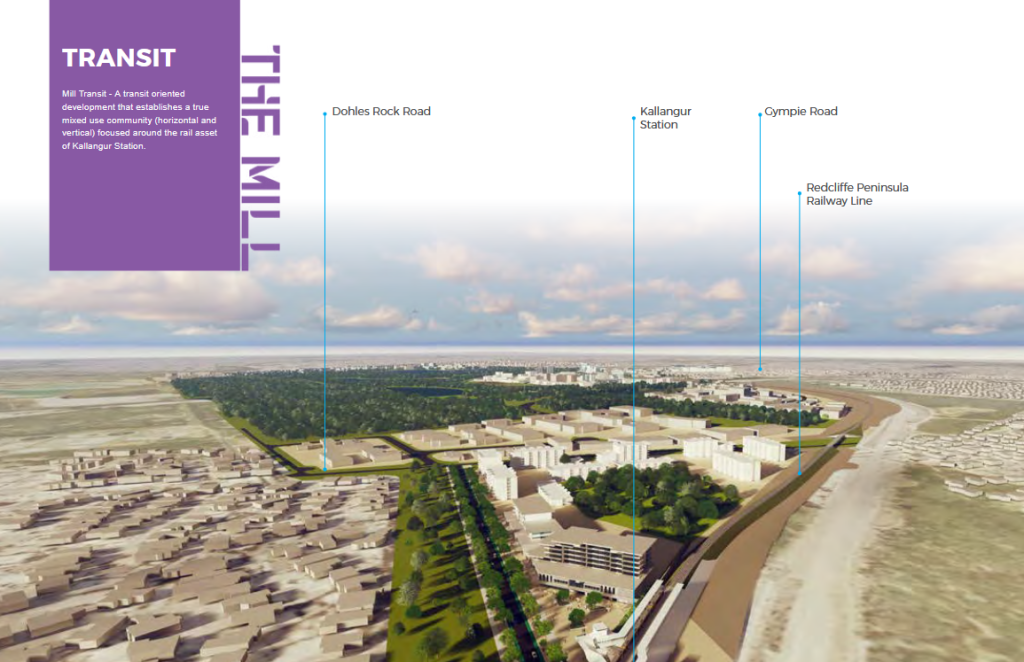
Mill Transit focuses development around Kallangur Station, reinforcing the transit-oriented model.
For existing Petrie homeowners, this means two structural forces operating simultaneously: increased housing supply and increased employment access.
Higher density near rail typically attracts students, young professionals and downsizers — shifting demographic composition over time.
Mill Green: Environmental Buffer and Liveability
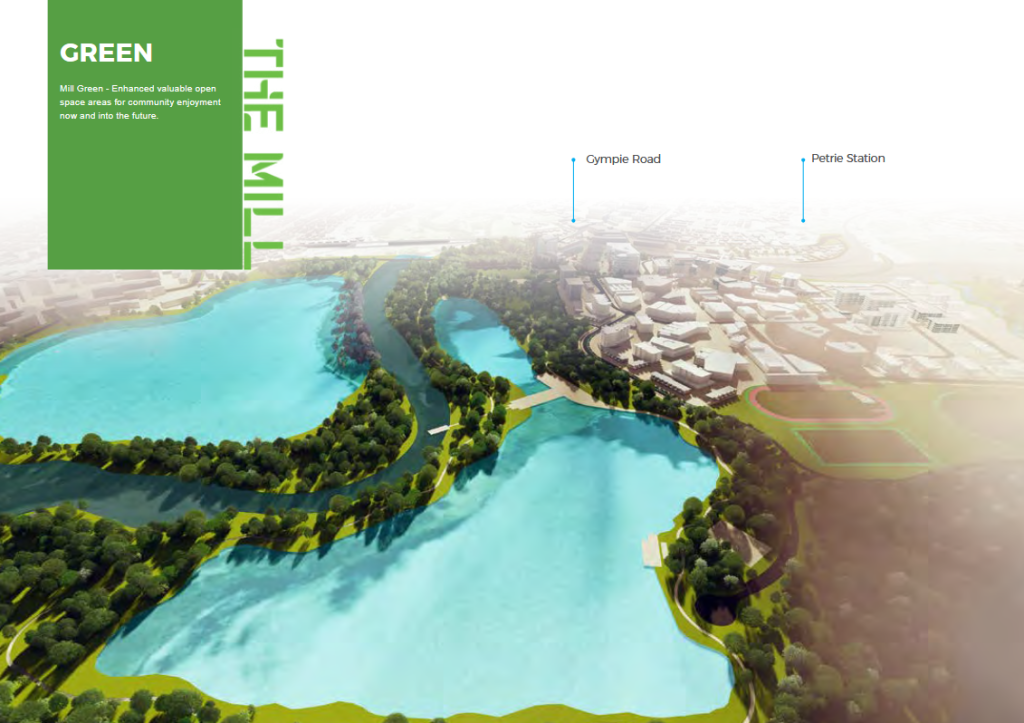
The PDA also includes approximately 110 hectares of conservation and koala habitat, alongside regional recreation parks and sport facilities integrated into the structural plan.
Wildlife veterinarian Jon Hanger described the environmental commitment as significantly expanding available habitat and welcomed the sustainable development approach.
Environmental buffers reduce long-term development risk while increasing liveability — a combination that often stabilises values in outer-metro precincts.
The Bigger Question for Property Owners
The Mill is not a short-cycle housing estate. It is a legislated economic transition anchored by a university and structured around transit, employment and environmental corridors.
Education is the entry point. Employment is the multiplier.
If the campus continues to expand course offerings, research partnerships and student numbers — and if commercial tenancy keeps pace — Petrie’s identity evolves.
The question for buyers and sellers is timing.
Is the suburb still being priced as a former industrial and commuter location?
Or has the market fully absorbed the implications of a university-anchored innovation precinct with thousands of future jobs built into its planning scheme?
Because on paper — and in law — the repositioning is already underway.
Published 20-February-2026
Editor’s Note: Planning and Development material and all images and infographics have been sourced from the The Mill at Moreton Bay Priority Development Area Development Scheme. View the complete document here.
