

Land Sales, Schools and Sewerage: The Development of Ferny Hills
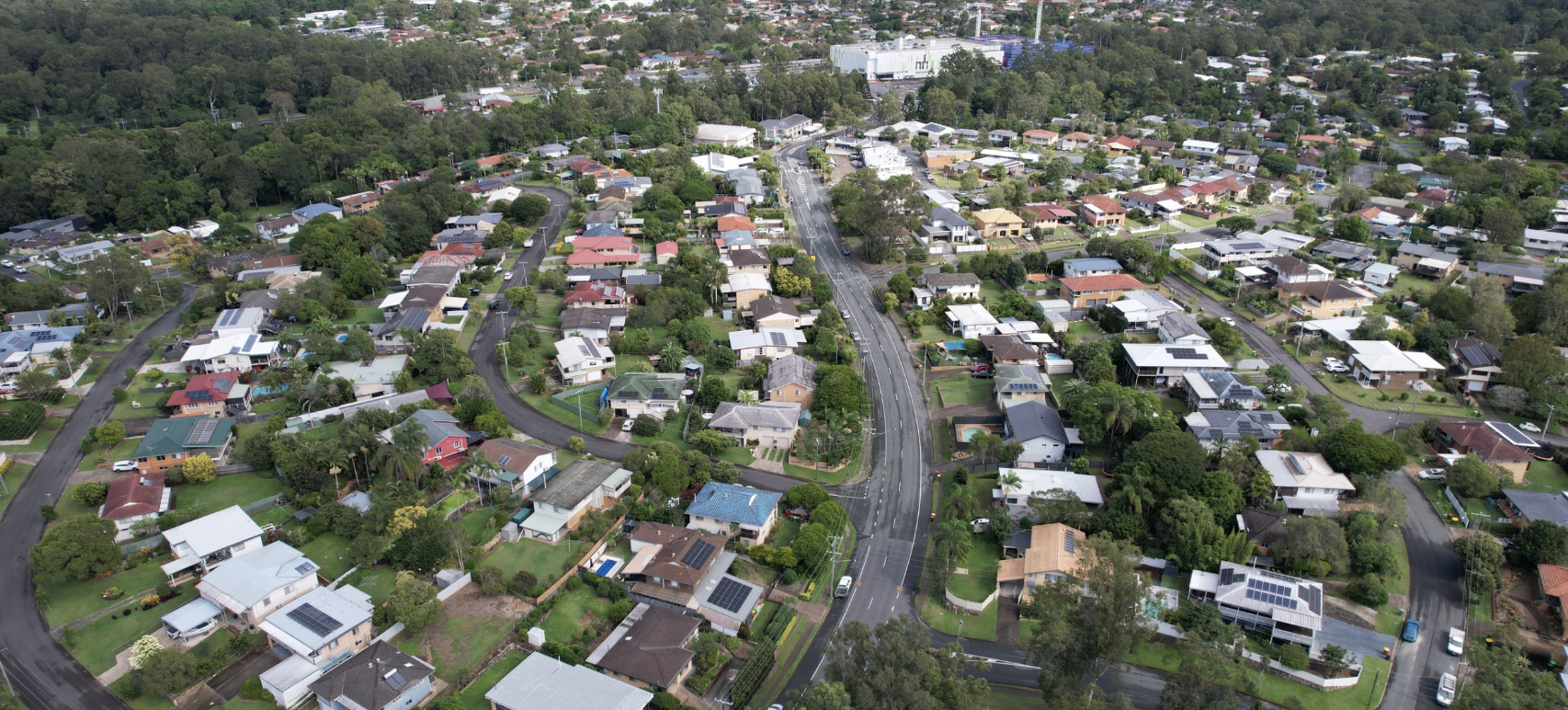
Ferny Hills is often regarded as a settled, established suburb on Brisbane’s north-west fringe. Its early development, however, was shaped by rapid subdivision, strong marketing and a population surge that outpaced essential infrastructure. The suburb’s formation reflects a familiar outer-Brisbane pattern of the post-war decades: land first, families next, services later. What distinguishes Ferny Hills is how clearly the documentary record captures that sequence — from electoral-roll marketing to delayed sewerage and a community that organised to fill the gaps.
Before the Name Was Official
In the late 1950s, Brisbane’s outer districts were increasingly viewed as viable residential frontiers. Land on the traditional country of the Yugarabul people was opened for private estate development as speculative subdivision extended beyond the established rail-line suburbs. Around 1959, suburbanisation linked to the Wilmore & Randell development began reshaping what was broadly marketed as “Ferny Grove”. The northern estate — the area that would later become Ferny Hills — was promoted and sold before it carried its own official name.
For more than a decade, buyers moved into what advertisements described as part of Ferny Grove, even though the locality we now recognise as Ferny Hills had not yet been gazetted. The distinction was administrative rather than practical. Houses were built, streets formed, and electoral rolls supplied mailing lists for promotional campaigns.
In August 1966, questions recorded in Queensland’s Hansard referenced the sale of homesites at “Ferny Grove”, including claims that selected recipients had been offered discounted blocks — correspondence drawn from electoral roll data. It is a rare parliamentary snapshot of how assertively these estates were marketed during Brisbane’s suburban expansion.
The name “Ferny Hills” was not formally gazetted until 1972. By that point, the community had already been living there for years. The suburb, in effect, existed socially and physically before it existed officially. That lag between settlement and recognition is central to understanding Ferny Hills’ early character: it was a place that developed in practice first, and on paper later.

Photo Credit: Moreton Bay Libraries
High-value transactions reflect a suburb that matured the hard way
The November 2025 to January 2026 sales window reads less like a short-term spike and more like the outcome of a suburb that has fully consolidated. The headline result — 6 Carrama Crescent, sold for $2,200,000 on 9 December 2025 by Simon Brigden — set the ceiling. But the stronger signal sits below it.
Look at the clustering. 9 Larwood Place achieved $1,615,000 through Peter Robertson and Melea Black-Sinclair, while nearby 26 Larwood Place reached $1,550,000 with Kelly and Regan Qualtrough. In the same November run, 21 Bel Air Court sold for $1,500,100 via Rochelle Adgo and 23 Calca Crescent secured $1,540,000. These are not isolated highs; they demonstrate depth across established residential pockets.
December reinforces the same depth across the high-$1 million bracket. Multiple sales transacted between roughly $1.22 million and $1.27 million, spanning both established residential streets and busier connectors, showing that premium pricing is not confined to a single pocket. Even at the lower end of the band, a result just under $1.1 million remained firmly above the million-dollar threshold — evidence of a consistent pricing floor rather than an isolated spike.
What emerges is not a one-off prestige outlier but a broad, high-$1 million band supporting multiple streets and agents. That depth matters. It suggests buyers are valuing the same fundamentals that early residents fought to secure: established infrastructure, functioning services, schools within reach, and residential streets that feel settled rather than speculative.
The suburb that once filled with families before it had sewerage or kindergartens now commands premium pricing precisely because those long-ago gaps were closed. The early years were about securing pipes, classrooms and roads. Today’s results show the payoff — a mature suburb where practicality underwrites price.
Recent sales results: Nov 2025–Jan 2026
- 2 Kirinya Street, Ferny Hills — $1,300,000, sold 06 Nov 2025
- 9 Larwood Place, Ferny Hills — $1,615,000, sold 10 Nov 2025
- 14 Wingara Grove, Ferny Hills — $1,200,000, sold 13 Nov 2025
- 23 Calca Crescent, Ferny Hills — $1,540,000, sold 15 Nov 2025
- 26 Larwood Place, Ferny Hills — $1,550,000, sold 20 Nov 2025
- 21 Bel Air Court, Ferny Hills — $1,500,100, sold 24 Nov 2025
- 85 Hutton Road, Ferny Hills — $1,095,999, sold 25 Nov 2025
- 67 Hutton Road, Ferny Hills — $1,225,520, sold 01 Dec 2025
- 55 Teenan Street, Ferny Hills — $1,275,000, sold 08 Dec 2025
- 6 Carrama Crescent, Ferny Hills — $2,200,000, sold 09 Dec 2025
- 16 Eurobin Crescent, Ferny Hills — $1,227,500, sold 11 Dec 2025
- 14 Tabulam Drive, Ferny Hills — $1,271,000, sold 28 Jan 2026
Read together, these results reinforce the same theme driving Ferny Hills’ appeal: premium money follows homes that make day-to-day living easier—multiple living areas, adaptable layouts, good land size and streets that feel calm and established. The top sale set the ceiling, but the broader pattern is the depth of demand across the high-$1m band, rather than a one-off outlier.
Families arrived first; services came later
Subdivisions in this area formed around 1960. Reticulated water arrived in the late 1960s, but sewering wasn’t completed until about 1974. It was a prolonged lag that left the district criticised as “sub-standard” while it struggled to meet the expectations of an expanding city. This explains the texture of those early years: families living in brand-new houses, in a place still negotiating the basics.
When services lag, communities organise. The Ferny Hills Progress Association’s history reads like a record of that determination. It describes a late-1965 meeting that led to the formation of the Association, with an early focus on securing a kindergarten — a need that speaks volumes about who was moving in.
By mid-1967, the history notes only about 150 occupied homes and a very young population: an estate filling quickly with children, prams, and the everyday pressure that builds when the nearest facilities are too far away.
Those years are easy to flatten into a neat “development story”, but the detail makes it human. Parents didn’t just wait for the suburb to be finished. They fundraised. They advocated. They built.
1970: kindergarten and school — the milestones that made it real
The kindergarten effort is a perfect example. In the Progress Association’s history, the opening of Willmore Kindergarten on 31 January 1970 is recorded as a milestone—the kind that transforms an estate into a community. In the same period, the local state school opened, another marker that the place had moved beyond “new” and into “here to stay”.

Photo Credit: Willmore Kindergarten/Google Maps
The Queensland Family History Society’s guide to schools lists Ferny Hills State School as opening on 27 January 1970, and the school’s own site also anchors its beginnings in that year. You can almost feel the shift: once there’s a school, the suburb stops being an idea and starts being a place people can name — and defend.

Photo Credit: Queensland State Archives/Flickr

Photo Credit: Wikipedia/Creative Commons Attribution 4.0 International

1972: the name becomes official — and the community followed
Then, in 1972, the name was locked in. It was the formal moment when the estate’s identity separated from Ferny Grove on paper. The Progress Association’s history captures how that official act rippled through local life: after the area name change was gazetted, the Association’s name was formally altered too, dated 16 October 1972.
It’s a small bureaucratic note, but it’s telling. The community didn’t just live in the new suburb; it adopted it, re-labelled itself, and carried on.

By the time sewering was completed around 1974, Ferny Hills had already spent more than a decade becoming itself the hard way: through rapid settlement and persistent local pressure.
The Progress Association history goes on to document the nuts-and-bolts work that followed — roads, drainage, street lighting, signage, tree planting, parks — the unglamorous infrastructure that makes a suburb feel safe and familiar. It’s the long middle of suburban history: not the first sale, not the official gazette, but the steady work of making the place function.

Photo Credit: Moreton Bay Libraries
A local landmark remembered: the Australian Woolshed
There are also cultural footprints—the things locals remember not because they’re in a planning document, but because they were distinctive.
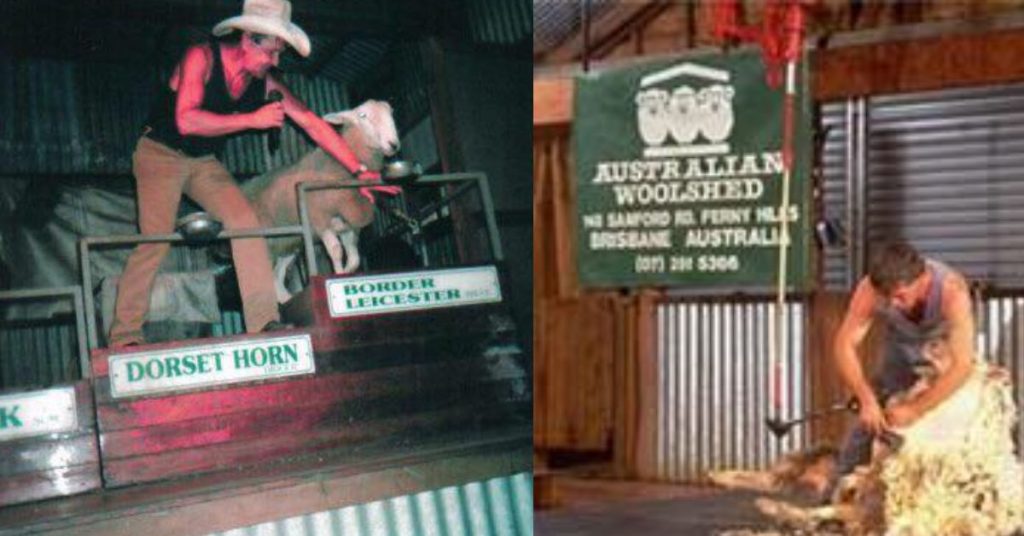
Ferny Hills once hosted the Australian Woolshed, a tourist attraction that later gave way to the Woolshed Grove residential development. It’s a reminder that suburbs don’t just grow; they recycle their landmarks. A site that once drew visitors can, in a different era, become the land on which families live.
Why Ferny Hills’ origin story still matters
What’s striking, looking back, is how much of Ferny Hills’ identity was forged before it was “finished”. Its origin story isn’t only about what was built; it’s also about what was demanded.
In the space between a marketed “Ferny Grove” estate and a gazetted Ferny Hills, you can see a familiar Queensland suburban pattern — big growth, delayed services, then community action to close the gap — but with a local stamp: a young population, an organised association, and a string of practical wins that helped turn a developing edge into a settled suburb.

Featured Image Credit: CityofMoretonBay
