

Historic Lookouts and Forgotten Views: The Places That Shape Woody Point
Woody Point can feel like a private world — the kind of calm you only get when the day hasn’t started asking anything of you yet. Along the foreshore, benches line the waterfront as if they’ve been placed there for one purpose alone: to hold people still, just long enough to watch the bay change its mind.
It’s an everyday scene, but it carries something older than routine. Because here, looking out across Moreton Bay isn’t just a pastime. It’s part of how locals keep time.
Woody Point’s bayside lookouts, from the Gayundah Coastal Arboretum to the jetty, are more than pretty stops on a morning walk. They’re time capsules — spaces that carry layers of history, community memory, and the quiet question that hangs over every changing shoreline: what do we keep, and what do we lose?
The Gayundah Coastal Arboretum: A View Built for Learning
The Gayundah Coastal Arboretum is one of those places that feels designed for lingering. Set beside the water, it’s planted with coastal-native flora and was originally intended as an instructional space, where schoolchildren could learn about local plant life in situ rather than from a textbook.

Today, it’s known as much for its atmosphere as its planting: a peaceful bayside park with seating, bay breezes, water birds, and open views across Moreton Bay — and on clear days, toward Moreton Island.
For locals, that combination matters. It isn’t only the open water that draws people in. It’s the sense that this lookout has been shaped with care. Even the layout encourages a kind of calm attentiveness: stop, sit, look, take a breath.
In communities like Woody Point, those small public invitations carry real weight. Because the places we return to, again and again, quietly shape how we live.

When Place Turns Into Price
That deep attachment to outlook, access, and atmosphere helps explain what’s been happening quietly — but decisively — in the local property market.
In the lead-up to Christmas 2025, Woody Point recorded a cluster of seven-figure sales, particularly among premium apartments positioned close to the foreshore. Recent results included:
- an apartment selling for $2.2 million at 104/16 Woodcliffe Crescent
- an apartment selling for $2.6 million at 201/16 Woodcliffe Crescent
- an apartment selling for $1.775 million at 21/36 Woodcliffe Crescent
Strong house sales followed close behind, with results including:
- $1.8 million at 5 Bailey Street
- $1.268 million at 32 Ellen Street
- $1.09 million at 32 Donald Street
- $1.022 million at 27 Bell Street
Across the 10 most recent recorded sales from late November to early December 2025, a clear pattern emerges. Bayside apartments with outlook, lift access and modern finishes are pulling well above $1 million, while houses show a broader spread depending on land size, renovation quality and proximity to the water.
It’s not just a story of rising prices. It’s a reflection of what people are paying for: daily access to views, walkable foreshore paths, and the feeling of living alongside something enduring.
A Name That Carries a Story: Gayundah on the Map
“Gayundah” isn’t just a park name. It echoes across Woody Point’s coastline, from signs to street names. Gayundah Esplanade, for example, was formerly known as Victoria Esplanade, before taking its current name from HMQS Gayundah.
The ship itself has a story that feels uniquely Queensland. Built as a gunboat for the colony’s maritime defence forces, Gayundah later served in the Royal Australian Navy.

Historical records note that the name was drawn from an Indigenous word commonly translated as “lightning”, and it is often paired with its sister ship Paluma, translated as “thunder”.
Even without knowing every detail, locals absorb that meaning over time. Names like this don’t sit in the landscape by accident. They’re reminders that bayside life here has always been connected to something larger — movement, defence, trade, and the constant negotiation with the sea.
The Beached Ship That Became Part of the Shoreline
Some coastal landmarks are planned. Others arrive through circumstance and stay long enough to become familiar.
In 1958, the hull of Gayundah was deliberately run aground at Woody Point to act as a breakwater — a practical decision that left a permanent imprint on the foreshore.
That detail alone says something about this place. Woody Point isn’t a coastline frozen in time. It’s one continually shaped by need, weather and community choices. The bay is beautiful, but it is also functional, lived-in and worked with.
Over time, landmarks like this become local reference points — the stories people gesture toward when they talk about “back then”, and the anchors that help new residents connect with older layers of the suburb.
Woody Point Jetty: The Bayside’s Long Conversation With the Sea
If the arboretum is a place to pause, the jetty is a place to gather.
Woody Point’s first jetty was built in 1881 to support trade between Sandgate and the peninsula — a practical structure that helped shape early settlement and growth.
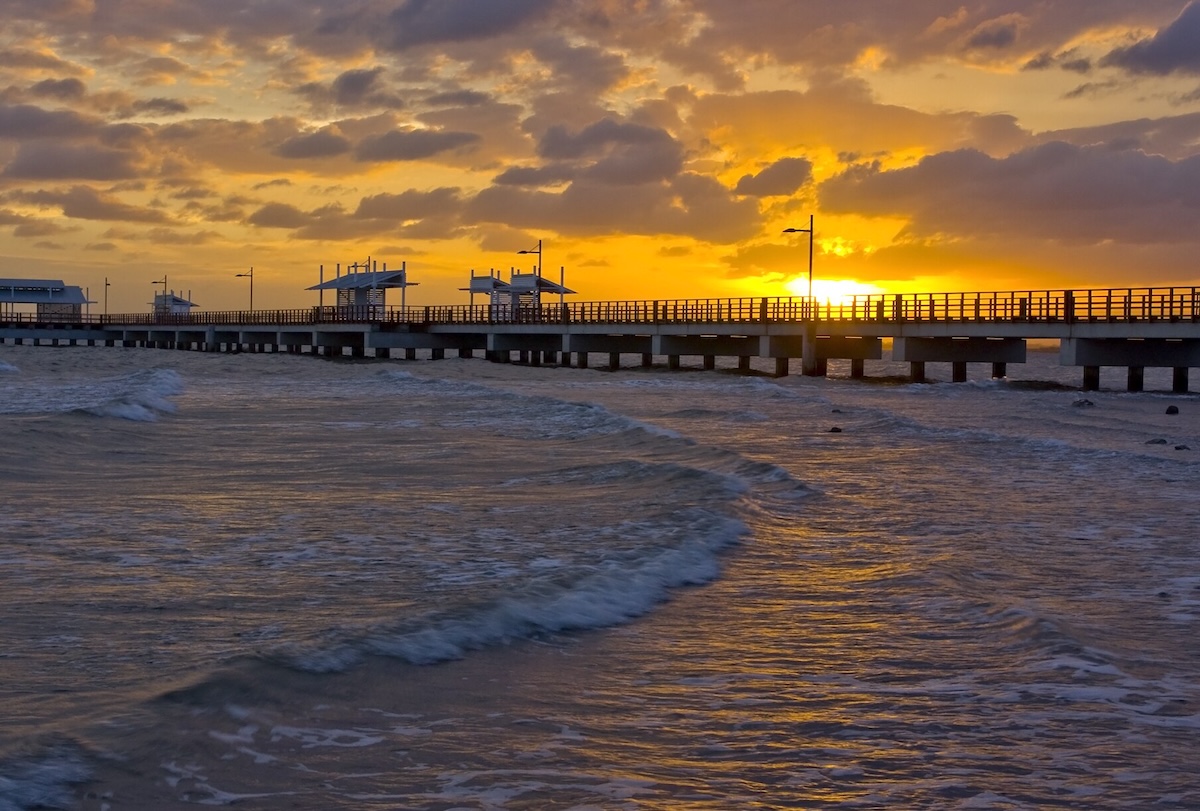
Generations later, the jetty remains woven into daily life: where fishing stories stretch longer than the line, where families lean into the wind for photos, where the bay feels close enough to touch.

Photo Credit: Ian Harding/Our Story Moreton Bay QLD
Like many long-loved public structures, it has been rebuilt and renewed. A 2008 Queensland Government statement noted that the current jetty was the third built on the site since the 1880s, delivered as part of a broader foreshore renewal.
That matters, because it shows what communities often understand instinctively: bayside spaces don’t endure on sentiment alone. They endure because people keep choosing to invest in them — financially, politically and emotionally.
The Forgotten Views: How Places Shift Without Anyone Noticing
In a place like Woody Point, change doesn’t always arrive loudly.
Sometimes it’s a view slowly obscured by growing tree lines. Sometimes it’s a stretch of foreshore that becomes less welcoming, less used, less safe-feeling. Sometimes it’s the cumulative pressure of development — more buildings, more people, all sharing the same narrow ribbon of waterfront.
And sometimes, change arrives as a challenge the community can’t ignore.
In early 2025, City of Moreton Bay announced the closure of Gayundah Arboretum Park for remediation works due to serious public health and safety concerns. The works, expected to take around six months, included sanitation, waste removal and the restoration of remnant vegetation to make the site safe again for community use.
For locals, that kind of disruption lands as more than a temporary inconvenience. It forces harder conversations about what public lookouts are for — and how compassion, safety and shared responsibility are balanced in real places.
Because lookouts aren’t just about views. They’re about access, and the sense that the coastline belongs to everyone.
Why These Bayside Spaces Matter to Locals
It’s easy to describe lookouts as “nice places”, but locals talk about them in more personal terms:
“That’s where I take visitors.”
“That’s my walking loop.”
“That’s where Dad used to fish.”
“That’s where I go to clear my head.”
Over time, places like Gayundah Arboretum and the jetty become stitched into everyday life. They hold milestones and habits: first bike rides, birthday fish and chips, quiet grief, new beginnings, and conversations that start with “Look at that sky” and end somewhere deeper.
There’s a steadiness in it. The bay is always changing, but it’s always there. And in a fast-growing region, that kind of constancy matters.
Holding the Future Without Losing the Past
Woody Point is changing, like every coastal suburb that has become more desirable, more connected and more noticed. But its most valuable assets aren’t private. They’re public.
They’re the bayside parks facing the water.
They’re the plantings designed to teach children what grows here and why it lasts.
They’re the jetty site that has served the community for well over a century.
They’re the place names that keep history visible, even when it’s easy to forget.
The challenge — and the opportunity — is to keep those spaces strong enough to carry the next layer of community life, without sanding away what made them meaningful in the first place.
Because the most iconic views aren’t just the ones you photograph. They’re the ones you return to, and recognise, even after time has changed almost everything else.

Featured Image Credit: Wikipedia/CC BY-SA 2.0
.jpg)
